
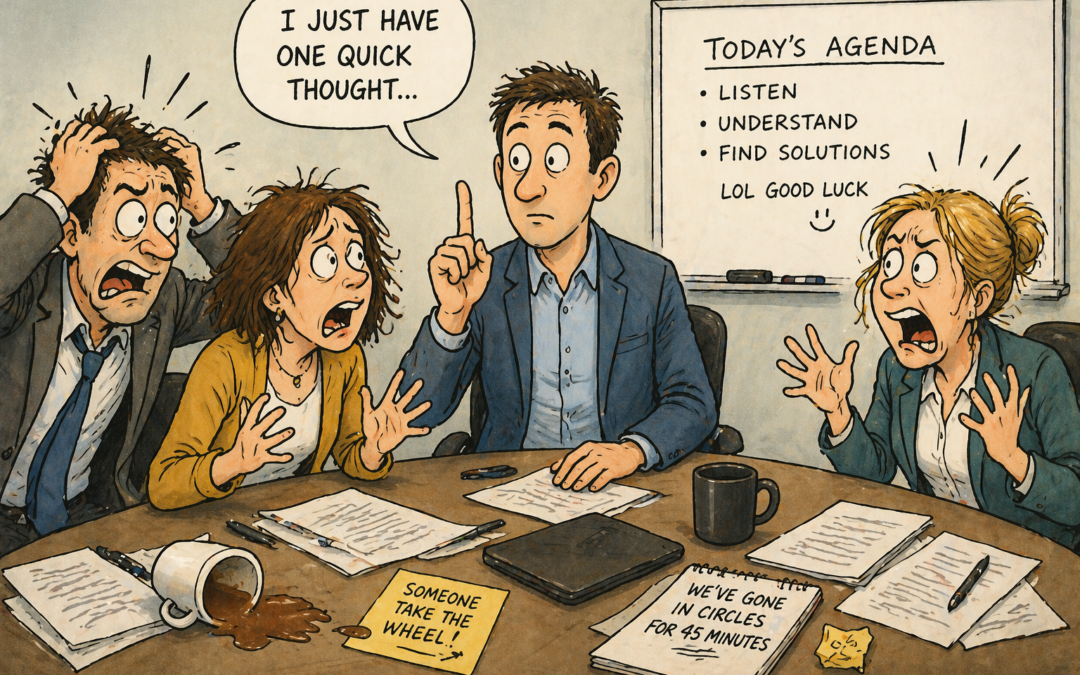
When to Interrupt in Mediation Is a Call You Have to Make
One of the hardest judgment calls in mediation is knowing when to interrupt in mediation.
People need room to talk. They need to feel heard. Sometimes they need to say something badly before they can say it well. If you interrupt too quickly, you can shut down something important.
At the same time, not every conversation deserves unlimited runway. Sometimes a person repeats, escalates, rambles, or causes damage. Sometimes the process needs protection.
That is the call a mediator must make. Getting it right requires constant attention to what the process needs.
Make the Call. Do Not Let Your Lizard Brain Make It for You.
A good interruption is a choice, not a reaction.
I want to be deliberate about my choices rather than reactive about my responses.
That is because bad interruptions usually come from reactivity. It tends to show up in a few predictable ways:
- Anxiety: The mediator feels the process slipping and jumps in too fast to regain control.
- Impatience: The mediator gets tired of repetition or slow progress and cuts someone off to move things along.
- Frustration: The mediator is irritated by the person or their behavior and responds with an edge rather than with judgment.
- Ego: The mediator feels challenged, misunderstood, or personally triggered and interrupts out of defensiveness or a need to take control.
These are easy traps to fall into. They feel justified in the moment. But in reality, they are just plain reactive and less effective.
Good interruptions come from slow, methodical, careful judgment about what the process needs next. You are tracking what is happening and deciding what matters. Then you choose your next move carefully.
The Move Starts Before You Open Your Mouth
A good interruption starts before you speak. It starts with a pause. For that, I use B.R.E.A.T.H.E.
B.R.E.A.T.H.E. is a reset sequence for the mediator:
- B = Breathe — Take a slow, deliberate breath. Pause fully. Interrupt the threat response.
- R = Recognize — Notice what is happening inside you and around you. Are you tense? Is someone about to blow, or is the other party shutting down?
- E = Ease your body — Unclench your hands and drop your shoulders. Let your body signal that it is safe to stay present.
- A = Anchor — Remember why you are there. Hold the structure of the process. Do not absorb the conflict or try to fix the people.
- T = Tune in — Listen past the surface. Is there fear under the anger? Shame driving the aggression? A need for control that has gone unmet?
- H = Hold boundaries — Stay calm and hold firm boundaries. Address harmful behavior and redirect when it interferes with the process.
- E = Engage with empathy — When the intensity settles, connect. Name what you saw.
Without that pause, we tend to go on reactive autopilot. With the pause of B.R.E.A.T.H.E., we take charge of our actions and act with purpose.
When to Interrupt in Mediation: Here Is When I Step In
The real question is whether the interruption will help move the process in a deliberate direction.
I interrupt when I am protecting the process.
Here is what it looks like:
- Stopping damage before it builds.
- Cutting off repetition that is burning time and getting us nowhere.
- Redirecting a conversation that has stopped being productive.
- Stepping in before one party says something that will make resolution harder.
But I do not interrupt just because something is uncomfortable. Some of the best moments in mediation are uncomfortable. A person may finally be saying something real. A party may be struggling their way toward a point that matters. The moment may feel awkward because something important is actually happening.
Interrupting too soon is counterproductive. I have seen many mediators lose the process by stepping in early in an effort to control it. In those moments, the better move is to push your chair back and listen.
A mediator needs to know that difference.
If the process is still moving somewhere useful, let it run.
If the process is breaking down, protect it.
That does not always mean saying something. Sometimes the most effective interruption is a deliberate silence or even stepping out of the session. Miles Davis famously said, “It’s not the notes you play, it’s the notes you don’t play.” The same is true here. What you choose not to say can move the process just as much as what you say.
One Time I Hit the Table and It Worked
A few years ago, a difficult client in caucus kept repeating himself and saying inappropriate things with no self-regulation at all. I made a deliberate choice at that moment to interrupt hard. So, I slammed my hand on the table. Now I would never recommend that as some general technique, and I would certainly not advise people to start pounding on furniture. But it was effective there because it was chosen carefully.
I had thought through who was sitting across from me. He was an athlete, a football player, and a Marine. We were in caucus, so there was no audience and no face problem. He needed a jolt. He did not experience it as an attack. Rather, he experienced it as a coaching move.
What mattered even more was what came next. I stopped, paused, and took a breath. I lowered my vocal tone and slowed my cadence. Then I said, “If you continue in this way, then we will not get anywhere. Would you like to change direction and go somewhere?” Then I waited in silence for his answer.
That interruption worked because it matched the person, the setting, and the needs of the process. It was not anger or frustration. It was not me losing control. Instread, it was a strategic, deilliberate and planned choice to intervene.
One Time I Lost It, and It Did Not Go Well
I have also gotten it wrong.
Once, I had a case with a client who was nasty, demeaning, and dropping F-bombs throughout the session. I never swear. Part of that is my faith, and part of it is that I think it usually signals lazy thinking. In that session, an F-bomb just fell out of my mouth before I even realized what happened. I was horrified with myself.
Afterward, I thought it through and realized what had happened. I had let the client control me. I had matched her manner and lowered myself. That was my mistake. I was embarrassed by myself and decided I would never let that happen again. I’m better than that.
In the first example, I was in control. In the second, the lizard brain took over. Lizard brains were great for when our ancestors were running from saber-toothed tigers. They are not very helpful when people are trying to divide a pension.
That is the difference between an intervention and an attack. An intervention is a choice. An attack comes from reaction.
Sometimes the Right Move Is to Walk Out
I saw that difference even more clearly in another case. Two clients were being awful to each other. I have a high tolerance for bad behavior, but they were getting close to the edge for me. I could feel myself starting to lose patience.
So I did not push through it. I interrupted the process by leaving the room.
I told them, “I am finding myself having a very difficult time with the behavior I am witnessing between the two of you. Right now, I am going to excuse myself and will return in a moment. I am not certain when I return if I will wish to continue with this mediation.” Then I calmly walked out and went to the restroom.
In the restroom, I looked in the mirror and did B.R.E.A.T.H.E. I slowed myself down. and cleared my thoughts. I took about ten minutes and came up with a plan.
When I came back, I thanked them for giving me time to collect my thoughts. I told them openly that I was triggered and that one of the important skills in mediation is staying in control of oneself. Then I asked whether they wanted to continue. They said they did.
I said, “If we are going to continue, then I will need some things in the way you speak to each other to change.” Then I laid out the ground rules I needed to keep going. I asked each of them for a verbal commitment. “Are you willing to let the other person finish before you begin speaking?” “Are you willing to speak to each other with respect?”
Those choices mattered. I used “if-then” statements and “I” statements. I framed each ground rule as a positive action instead of a prohibition. Let the other person finish is better than do not talk over each other. Speak with respect is better than stop being rude.
That reset worked because I got myself under control before I tried to guide the clients.
This Is Not About Looking Good
A mediator should not interrupt to perform. A mediator should not try to look dramatic, clever, or powerful. Some interventions carry energy. A firm interruption, a hand on the table, walking out of the process. From the outside, those things can look performative. They should not feel performative.
I am not here to perform. I am here to help the process move.
That is the standard.
The move has to be deliberate and fit the moment. It has to serve the process and cannot be a discharge of the mediator’s own frustration. An intervention cannot become manipulation. We are helping the clients change directions.
When to Interrupt in Mediation: The Standard I Use
So when should you interrupt?
Interrupt when the process needs protection.
Let it run when the process is still doing useful work.
Step out when you need to regain control of yourself before trying to guide anyone else.
Before you speak, ask yourself one question.
Am I making a choice right now, or am I just having a reaction?
That question will save you a lot of bad interruptions.
Very helpful! Thank you.
Ed
I am glad it resonated. Cheers!