
by Shawn Weber, JD, CLS-F* | Jul 8, 2026 | Family & Divorce Mediation
Fans of The Hitchhiker’s Guide to the Galaxy know that the guide offers one essential piece of advice in large, friendly letters: Don’t Panic. This is especially important when you’re wondering how to stay calm during divorce mediation.
It is good advice for travelers unexpectedly launched into the chaos of the universe. It is also good advice for people beginning a divorce or other family law dispute.
The first days of separation can feel disorienting. A text message arrives. An email appears. A difficult conversation goes badly. Suddenly, every issue feels urgent, and every decision feels permanent.
That is when people are most vulnerable to making poor choices.
Fear creates urgency. Urgency creates mistakes.
At Weber Dispute Resolution, clients often hear a simple reminder: slower is faster.
When people slow down enough to gather information, ask better questions, and think clearly, they often move the case forward more efficiently and with fewer expensive detours.
One of the greatest strengths of mediation and Collaborative Practice is that they create a process. A good process helps people slow down, gather information, ask better questions, and make decisions from a place of greater stability.
The goal is not to pretend fear is unreasonable. Instead, it’s to keep fear from making the decisions and allow space for a clear, defined path forward.
Conflict changes the way people think.
When a person feels threatened, the brain starts scanning for danger. It fills in gaps with assumptions. It treats uncertainty as proof that something terrible is about to happen.
That is why one unanswered question can quickly become a frightening story.
Will I lose time with my children? Will I be financially secure? Will my spouse be reasonable?
These are normal questions. They deserve serious attention. They do not need to be answered in the middle of an emotional surge.
In mediation and Collaborative Practice, people are not expected to solve every issue at once. The process breaks large problems into manageable parts. Parenting, support, property, budgets, and disclosures can be addressed in an organized way.
That structure matters because it gives people room to breathe and paves the way for more thoughtful conflict resolution.
Trusting the Process Does Not Mean Giving Up Control
Some people hear the phrase “trust the process” and worry that it means becoming passive.
It does not.
In mediation and Collaborative Practice, clients remain active participants. They ask questions. They gather documents. They consult with professionals. They consider options. They make decisions.
Trusting the process means understanding that good decisions usually require good information.
A person does not need to know every answer at the beginning of the case. Most people cannot. What they need is a reliable way to move from confusion to clarity.
That is what a sound process is designed to provide. It moves clients from confusion toward practical decisions, as the next section will explore.
A Good Process Leads to Better Decisions
Divorce involves legal issues, financial realities, emotional stress, and family relationships. Those issues are often tangled together.
When people panic, they usually focus on one part of the problem and lose sight of the larger picture.
A parent may become so focused on one holiday that the larger parenting plan gets lost. A spouse may become so worried about one account that the full financial picture becomes harder to see. A person may react to one angry message as though it defines the entire future.
A good process creates space between the immediate emotion and the long-term decisions. That space leads to better judgment.
The River May Be Rough, and the Boat Can Still Be Fine
Divorce mediation is sometimes like whitewater rafting.
People do not hire a guide because the river is calm. They hire a guide because the guide understands the rapids.
The guide cannot remove every rock from the river. The guide cannot promise that nobody will get wet. The guide can read the current, anticipate hazards, and help people navigate rough water without making the ride more dangerous than it needs to be.
Mediation works in a similar way.
There may be difficult conversations. There may be emotional moments. There may be proposals that are rejected before better ones are developed.
That does not mean the process is failing.
Conflict often rises before it resolves. Experienced mediators expect that. They know how to help people stay engaged when the conversation becomes uncomfortable.
A hard meeting is not the same thing as a failed meeting. Sometimes it is the meeting where the real work begins.
Do Not Panic Because Your Spouse Hired an Attorney
Many people become alarmed when the other spouse hires an attorney.
That reaction is understandable. It can feel like the case has suddenly become adversarial.
In many cases, legal advice can actually support mediation. Clients often make better decisions when they understand their rights and responsibilities. Additionally, when clients have a clear understanding of all of their options, including ideas outside the box, the decision making is usually much better. Consulting counsel can help a person prepare, evaluate proposals, and avoid agreements that were not fully understood.
The presence of an attorney does not automatically mean the process is over. It may mean the process has more support.
Do Not Panic Because You Do Not Have All the Answers
Most clients begin mediation with incomplete information. This lack of information can make it very hard to know how to remain calm during divorce mediation.
That is normal.
They may not know the house’s value. They may not understand retirement accounts. They may be unsure about support. They may not know what parenting schedule will work best once everyone is living in separate homes.
The early stage of mediation is often about identifying what still needs to be learned.
Questions are not a sign of failure. Questions are part of the way ahead.
Do Not Panic Because Settlement Takes Time
Some cases settle quickly. Others require patience.
That does not mean anyone is doing it wrong.
People need time to absorb information. They need time to think. They need time to test options. They need time to move from emotional reaction to practical decision-making.
Speed is not the only measure of success.
A rushed agreement can create new conflict later. A thoughtful agreement is more likely to last.
The purpose of mediation is to help people reach an informed agreement they can actually live with.
Even though it may not feel natural, keeping calm is a skill folks can learn and practice.
People practice it when they pause before responding, ask questions instead of making assumptions, and wait for information before reaching conclusions.
They also practice it by remembering that the process has a sequence.
First, identify the issues. Next, gather the information. Then, develop options. After that, evaluate choices. Then make decisions.
When people try to do all of that at once, panic takes over. When they follow the process, clarity has a chance to emerge.
You Only Need the Next Thoughtful Step
When thinking about how to stay calm during divorce mediation, people can sometimes feel as though they must solve the rest of their lives immediately.
They do not.
They need the next thoughtful step.
That step may be compiling documents. It may be scheduling a meeting. It may be consulting with an attorney. It may be preparing a budget. It may be taking a break before responding to a difficult message.
People will move forward in their cases most effectively if they take one small, thoughtful step at a time. Panicky people will often rush past the information-gathering stage and demand certainty before they understand the facts. A careful process helps folks reach clarity more reliably and more efficiently.
The Guide Was Right
There is no magic button that makes divorce easy. There is no perfect script for every hard conversation. There is no way to remove all uncertainty from a major life transition. Knowing how to stay calm during divorce mediation can sometimes be plain tough.
There is, however, a way to move through conflict with structure, support, and greater steadiness.
That is why mediation and Collaborative Practice can be so valuable. They help people make decisions without letting fear make those decisions for them.
You do not need a towel to get through mediation.
You do need patience, good information, and a process you can trust.
The Hitchhiker’s Guide got one thing exactly right:
Don’t panic.

by Shawn Weber, JD, CLS-F* | Jul 2, 2026 | Professional Practice & Training
A session can start calmly and shift fast. This is where mediator self-regulation becomes crucial.
You have been there. The mood of the session changes. Someone’s voice goes up. An attorney interrupts. A client shuts down or floods. The air in the room thickens. And somewhere in the middle of that, you notice something happening in you.
Breathing becomes shallow. You’re talking more and listening less. You speed up the pace. Perhaps you are deciding internally who is making sense and who is making noise. You are reaching for control before you have registered that you lost your footing.
That’s the tilt. It’s when the room shifts and you feel yourself pulled off-center. Every mediator experiences it. Your mediator role places you in intense moments when sudden shifts can happen really fast. The key is recognizing the tilt and making a conscious choice to reclaim your Still Center. Self-regulation starts with noticing this shift and deciding how you respond.
Think about the eye of a hurricane. The storm is fully present, rotating at full force, and right in the middle of it there is a patch of still air. The eye doesn’t stop the hurricane. It just isn’t part of it. That is the image behind the Still Center. Family mediation can get hellacious. Marriages ending, finances unraveling, kids caught in the crossfire, people saying things they won’t be able to take back. Our craft asks you to sit in the middle of all of that without adding to the chaos. You are in the calm, still eye. The wind is from others. Your job is to stay there.
Key Takeaways
- Mediators often experience a tilt during sessions, causing them to lose their center and react to noise rather than underlying issues.
- Maintaining a Still Center is crucial for effective mediator self-regulation, allowing practitioners to stay calm amidst conflict.
- Practicing the BEGIN protocol—Breathe, Explore, Ground, Intentionally Slow, Next Step—helps mediators regain focus in high-pressure situations.
- Mediator self-regulation stabilizes the process, protects neutrality, and reduces the long-term emotional cost of difficult sessions.
- Most training overlooks the importance of self-regulation, emphasizing the need for ongoing practice and reflection to develop the Still Center.
What Happens When You Lose the Still Center
When a session tilts and you get sucked into the vortex, a recognizable pattern tends to follow. You might start talking more and listening less. Maybe you start speeding up when people need to slow down. You could find yourself quietly favoring the person who seems more reasonable, and pushing toward agreement before the ground is ready for it. Good practitioners get caught this way all the time. The moment moves fast, and by the time you feel it you are already inside it.
Even when your session tilts, you need to stay centered. With all of the surface intensity of raised voices and entrenched positions, a skilled mediator will look underneath to find the client’s interests, values, and needs. Your primary task is to hold your still center so you can work with these deeper layers, not just react to the noise. This steadiness is the foundation of mediator self-regulation.
The Still Center Is a Practiced Discipline
The Still Center is a skill. While some mediators are naturally calmer than others, steadiness under pressure develops with hard work, which requires a ton of repetition and self-awareness.
You can spot the markers physically. They include slower breathing, a softer gaze, an unhurried cadence, or a settled posture. The participants register all of that before you have said a word.
The Still Center works like this: in the center of the storm, you bring clear air. The wind is from others. Be active, boundaried, calm, present, and steady while the conflict keeps moving.
This distinction is vital. Stillness in a tilted room means maintaining engaged presence with the storm of the conflict swirling around you. This is the main challenge and purpose of mediator self-regulation. It requires real-time awareness to recognize your internal responses, contain them, and then make deliberate choices as the session unfolds.
BEGIN: A 30-Second Personal Reset
One tool worth building into your practice for mediator self-regulation is the BEGIN protocol. The acronym stands for Breathe, Explore, Ground, Intentionally Slow, and Next Step. The whole sequence takes under thirty seconds and can be run inside an active session without anyone knowing you are doing it.
You start with breath. Inhale for four counts, exhale for six, and do it twice. The longer exhale is what matters physiologically. It engages the part of your nervous system that down-regulates the stress response. You do it quietly, at the table, while the session continues.
Then you explore what’s going on inside you. Name one body sensation and one feeling word. Make it something simple like a tight chest or shallow breathing, a sense of impatience or mild dread. The act of naming creates a small gap between what you are feeling and what you do next, and that gap is where choice lives. You are observing your own state, not solving it.
Grounding comes next. Feel your feet on the floor. Lengthen your spine. These are physical moves that return you to the room after the room has started to pull you somewhere else.
Then you intentionally slow down. Lower your voice. Ease the pace. Shorten your sentences. Clients tend to follow the mediator’s tempo, and a slower mediator gives the session more room to breathe.
From there, you deliberately choose one next move. It might be a clarifying question or a brief process intervention. The point is that you are choosing it deliberately rather than reacting to whatever is loudest in the room. You’re back in the session instead of being carried away by the storm.
The Layers Underneath the Tilt
One reason mediators get pulled in is that they respond to the surface of what is happening rather than what is underneath it. The room gets loud, and you react to the noise. But the noise is rarely the whole story. This is where mediator self-regulation becomes crucial.
When a session tilts, there is usually more going on than the presenting conflict. Beneath the heat of a difficult exchange, there are positions, interests, values, and needs that have not yet been named. Working any one of those layers tends to move things. Chasing the energy directly tends to amplify it.
When things start to shift in a difficult direction, your first move is physical. Slow way down, lower your voice, ease the pace of the room. Once you have done that, get curious about what is underneath. A single well-placed question will do more than trying to redirect the whole session at once. If the room needs a pause, name it and take one.
Hard sessions are part of what we do, so get used to it! Intensity is workable. What changes the picture is coercion, and a mediator who is grounded can tell the difference between a room that is hot and a room that has crossed into something that requires a different response.
What Self-Regulation Actually Protects
Mediator self-regulation operates on several levels simultaneously. You’ve got to be aware of each.
Mediator self-regulation stabilizes the parties. When you stay steady, others can draw on that steadiness, which holds the space open for resolution. This is the load-bearing function of the mediator: your composure supports the entire process.
That composure will protect you neutrality. A mediator who has been pulled in by the room, who has quietly decided who is reasonable and who is difficult, who is pushing for resolution out of anxiety, has drifted from the chair they are supposed to occupy. Self-regulation keeps you there.
It sustains the process. When a session tilts and the mediator holds steady, the process can continue to do its work. When the mediator tilts with the room, reaction takes over.
It reduces the long-term cost of the work. Over a career, the accumulation of hard sessions without a deliberate practice for managing your own activation wears practitioners down. The Still Center serves the long game as much as any single session.
Practicing What Is Rarely Taught
Most mediation training covers process, structure, technique, and law, but misses the mark when it comes to mediator self-regulation. The internal work, what to do with yourself when a session becomes personally triggering for the practitioner, gets far less attention.
That gap is understandable. This is hard to teach in the abstract. You learn it in real rooms, and mostly you learn it from the sessions that got away from you. Afterward, you debrief and go back over what happened. You look at where you started to lose your footing and what you might have done sooner. Do that honestly enough times, and you’ll find more steadiness more consistently.
Those questions, asked honestly over time, are how the Still Center develops. It’s a habit, earned through practice.

by Shawn Weber, JD, CLS-F* | May 13, 2026 | Family & Divorce Mediation
[This article was originally posted in 2016. It has been revised and republished on 5/13/2026.]
Choosing a mediator matters. The person you hire will sit in the middle of one of the most consequential negotiations of your life. A good mediator keeps the process moving, helps you make informed decisions, and gets you to an agreement that holds up. For best results, consider the questions to ask a divorce mediator before making your choice. A mediator who lacks training or experience can cost you time, money, and a durable outcome.
California has no licensure requirements for mediators. Anyone can hang a shingle. That makes it your job to ask the right questions before you commit. One important step is to have a list of questions to ask a divorce mediator in advance.
Here are five worth asking. These are some of the key questions to ask a divorce mediator in order to ensure a good fit for your situation.
1. What training have you completed, and how recently?
Mediation requires a specific set of skills. Listening, reframing, managing impasse, drafting workable agreements. These are learned skills, and they need to be maintained.
Ask how many hours of mediation training the person has completed. Ask when they last took a course. A mediator who completed a 40-hour training fifteen years ago and has done nothing since is working with outdated tools. Look for someone who invests in ongoing education.
Most mediators come from a professional background in law, mental health, or finance. That background matters because it shapes what they bring to the table.
A mediator with a law license can draft settlement agreements with an understanding of how courts will read them. A mediator with a mental health background brings skill in managing high-emotion conversations. A financial professional adds value when the case involves complex assets or support calculations.
Ask what credentials they hold and whether those licenses are current. If someone carries a professional license, verify that it is active. If they have no underlying credential at all, ask what qualifies them to handle your case.
Some mediators do this work full time. Others mediate occasionally alongside a litigation practice or a therapy practice.
Volume matters. A mediator who handles cases regularly has seen more situations, developed more tools, and refined their process through repetition. Ask how many cases they handle per month and how long they have been mediating. Experience in the chair builds judgment that training alone cannot provide. You can also use these opportunities to bring up any additional questions to ask a divorce mediator.
4. What does your process look like, and how long does it typically take?
A thorough divorce mediation takes time. If someone promises to resolve everything in a single session, be cautious. Marriages involve finances, property, support, and often children. Unwinding all of that properly requires multiple sessions, proper disclosure, and time to think between meetings.
Ask the mediator to walk you through their typical process. How many sessions should you expect? What happens between sessions? How do they handle financial disclosure? What does the final agreement look like?
A mediator who can describe a clear, structured process has thought about how to get you from the first meeting to a signed agreement. That structure is what keeps things on track when the conversations get difficult.
5. How do you handle conflict in the room?
Every mediator has a style. Some are more facilitative, meaning they focus on helping you and your spouse communicate and reach your own decisions. Others are more evaluative, meaning they offer opinions on likely court outcomes or the strengths of each position.
Ask the mediator to describe their approach. Ask how they handle it when one party gets stuck or when emotions run high. The answer will tell you a lot about whether this person can manage the reality of your situation.
One More Thing: Get Your Own Legal Advice
Even when your mediator is a licensed attorney, the mediator works for the process, not for either party. A mediator cannot give you individual legal advice. During mediation, consult with your own attorney to make sure you understand your rights and that the decisions you are making are informed ones.
Choosing the right mediator is worth the effort. Take the time to ask these questions before your first session.

by Shawn Weber, JD, CLS-F* | May 11, 2026 | Professional Practice & Training
A strange moment can happen in mediation when the mediator neutrality starts slipping toward one side. The shift usually begins quietly. One person in the room may start making more sense to you. Another may seem more emotionally grounded. At times, somebody reminds you of a person from your own life. You may also notice yourself becoming impatient with one party while feeling protective toward the other.
Most mediators have experienced this, yet very few people talk honestly about it. Neutrality often gets discussed as though it were a fixed condition that, once chosen, simply remains in place for the rest of the mediation.
Neutrality moves. It gets tested, pulled on, and stretched. Sometimes the pull is obvious. A party is openly abusive. Somebody is lying badly. One person is clearly trying to intimidate the other. Most mediators can recognize those moments.
Subtle situations create a bigger challenge. A mediator may slowly begin to identify with one side without fully realizing it. One party may communicate more clearly. Another may seem calmer and more rational. Somebody may even remind the mediator of a difficult former client, an ex-spouse, a parent, or themselves.
The mediator starts tilting a few degrees without noticing, and the shift usually shows up in small ways rather than in dramatic ones. A mediator may reality test one side more aggressively than the other. One person receives more warmth. Another gets interrupted more often. Gradually, the mediator becomes slightly more skeptical of one narrative and slightly more accepting of the other.
These can seem small, but small shifts matter because people are quite sensitive with respect to fairness. They may not understand mediation theory, but they know when the vibe in the room changes. People can tell when the mediator starts sounding different with one person than with the other.
Skilled mediators notice their internal reactions early enough to keep those reactions from steering the process. That awareness matters because the draw toward one side can come from very different places. Sometimes the tug comes from personal bias.
A mediator may have strong feelings about infidelity, money, parenting, control, addiction, passivity, anger, or power. Certain behaviors may bring up old experiences or assumptions the mediator did not realize were still sitting under the surface. That is part of being human. Mediators walk into sessions carrying histories, personalities, values, experiences, strengths, blind spots, and emotional memories that affect how they experience conflict.
Honest self-awareness helps mediators recognize their reactions and manage them responsibly. Some internal reactions also reflect real concerns relating to fairness, pressure, safety, or whether the process is working properly.
At times, one side really is making a weaker argument. In other situations, somebody may be distorting reality. A proposal may also be unrealistic, manipulative, financially unsound, or emotionally coercive. Mediator neutrality requires honesty, clear thinking, and good judgment. Mediators can acknowledge when a position is unrealistic or poorly grounded while still treating both people with fairness, dignity, and respect.
Good mediators ask hard questions while staying fair and balanced, especially when the line between helping and pushing starts getting blurry.
A mediator may need to challenge one person more than the other during a particular moment because that person is farther from reality. A mediator may need to slow down an aggressive participant to keep the process fair and productive. A mediator may need to interrupt behavior that is intimidating or destructive.
These moments test a mediator’s self-awareness and call for deliberate thinking and good judgment. When the pull starts happening, a mediator benefits from pausing and asking a few hard questions.
- What exactly is happening inside me right now?
- Where is this reaction coming from?
- Is this about the current mediation, or is this pulling on something from the past inside me?
- Am I reacting to the person or to the behavior?
- Is my concern grounded in process fairness and realism, or am I slipping into judgment and emotional alignment?
Those questions matter because mediators who lack self-awareness often start letting their reactions drive their behavior without realizing it. Some mediators start rescuing. Others overcorrect. A mediator may become colder with one side or subtly punish behavior they dislike. Curiosity starts disappearing from the conversation. Perhaps most dangerously, the mediator stops realizing any of this is happening.
Experienced mediators approach mediator neutrality with awareness, steadiness, and self-control while continuing to guide the process with balance and purpose.
That takes discipline. It also takes humility. Every mediator has blind spots. Some personalities are easier for a mediator to work with than others. Every mediator has emotional triggers. There are also days when patience comes more easily than on others.
Mediators need to recognize those reactions early enough to keep the process balanced and productive.
Some mediators become so focused on appearing neutral that they stop using their judgment. Some stop challenging unrealistic thinking. Others avoid difficult conversations altogether. Many become passive because they are afraid any intervention will appear biased.
Mediation requires structure and a steady process when emotions start pulling people sideways. Effective mediators accept that progress in the meeting frequently involves some moments of discomfort.
Balance, steadiness, and good judgment matter most when the pressure rises.
There are times when fairness calls for clear structure, firm boundaries, and thoughtful handling of the process. A mediator dealing with controlling behavior, intimidation, serious emotional imbalance, or manipulation may need to become more active in protecting the integrity of the process itself.
A mediator in those moments may become more active in preserving balance because a serious inequality can quickly shut down honest conversation. Keeping the process fair sometimes requires a stronger structure, firmer boundaries, direct interruption, or more active guidance of the conversation. Those interventions protect the integrity of the mediation and help maintain meaningful participation.
Mediators need to stay honest with themselves about why they are stepping in and what is driving the decision.
Mediation requires managing other people’s conflicts while also managing yourself within the conflict. Few skills shape mediator neutrality more than that one.
by Shawn Weber, JD, CLS-F* | Apr 22, 2026 | Professional Practice & Training
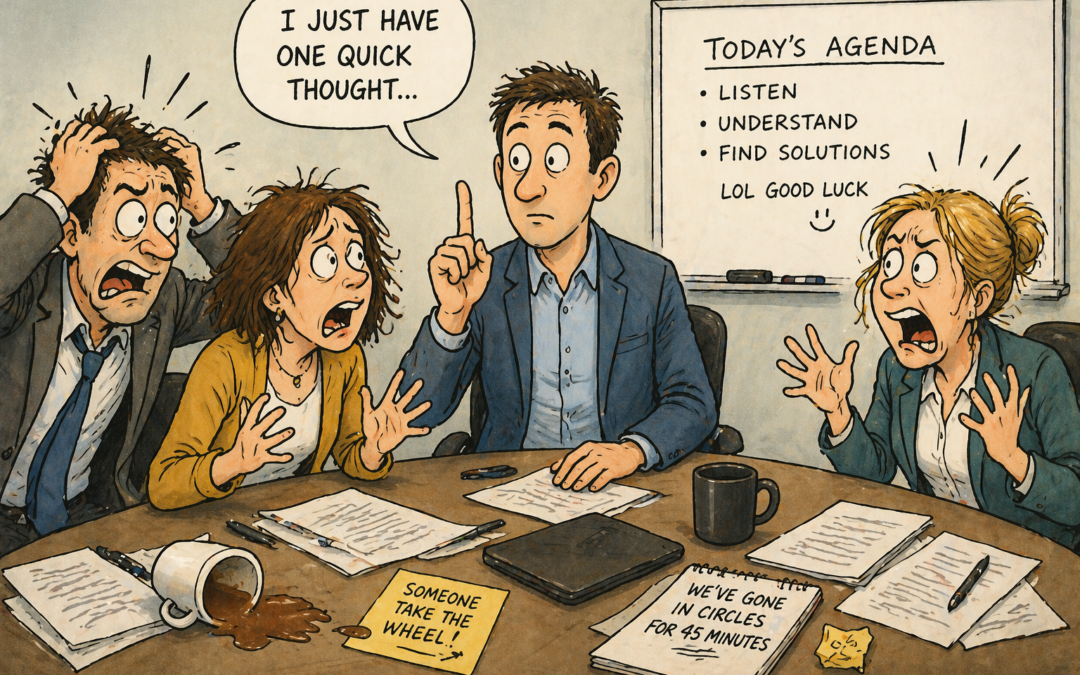
One of the hardest judgment calls in mediation is knowing when to interrupt in mediation.
People need room to talk. They need to feel heard. Sometimes they need to say something badly before they can say it well. If you interrupt too quickly, you can shut down something important.
At the same time, not every conversation deserves unlimited runway. Sometimes a person repeats, escalates, rambles, or causes damage. Sometimes the process needs protection.
That is the call a mediator must make. Getting it right requires constant attention to what the process needs.
Make the Call. Do Not Let Your Lizard Brain Make It for You.
A good interruption is a choice, not a reaction.
I want to be deliberate about my choices rather than reactive about my responses.
That is because bad interruptions usually come from reactivity. It tends to show up in a few predictable ways:
- Anxiety: The mediator feels the process slipping and jumps in too fast to regain control.
- Impatience: The mediator gets tired of repetition or slow progress and cuts someone off to move things along.
- Frustration: The mediator is irritated by the person or their behavior and responds with an edge rather than with judgment.
- Ego: The mediator feels challenged, misunderstood, or personally triggered and interrupts out of defensiveness or a need to take control.
These are easy traps to fall into. They feel justified in the moment. But in reality, they are just plain reactive and less effective.
Good interruptions come from slow, methodical, careful judgment about what the process needs next. You are tracking what is happening and deciding what matters. Then you choose your next move carefully.
The Move Starts Before You Open Your Mouth
A good interruption starts before you speak. It starts with a pause. For that, I use B.R.E.A.T.H.E.
B.R.E.A.T.H.E. is a reset sequence for the mediator:
- B = Breathe — Take a slow, deliberate breath. Pause fully. Interrupt the threat response.
- R = Recognize — Notice what is happening inside you and around you. Are you tense? Is someone about to blow, or is the other party shutting down?
- E = Ease your body — Unclench your hands and drop your shoulders. Let your body signal that it is safe to stay present.
- A = Anchor — Remember why you are there. Hold the structure of the process. Do not absorb the conflict or try to fix the people.
- T = Tune in — Listen past the surface. Is there fear under the anger? Shame driving the aggression? A need for control that has gone unmet?
- H = Hold boundaries — Stay calm and hold firm boundaries. Address harmful behavior and redirect when it interferes with the process.
- E = Engage with empathy — When the intensity settles, connect. Name what you saw.
Without that pause, we tend to go on reactive autopilot. With the pause of B.R.E.A.T.H.E., we take charge of our actions and act with purpose.
The real question is whether the interruption will help move the process in a deliberate direction.
I interrupt when I am protecting the process.
Here is what it looks like:
- Stopping damage before it builds.
- Cutting off repetition that is burning time and getting us nowhere.
- Redirecting a conversation that has stopped being productive.
- Stepping in before one party says something that will make resolution harder.
But I do not interrupt just because something is uncomfortable. Some of the best moments in mediation are uncomfortable. A person may finally be saying something real. A party may be struggling their way toward a point that matters. The moment may feel awkward because something important is actually happening.
Interrupting too soon is counterproductive. I have seen many mediators lose the process by stepping in early in an effort to control it. In those moments, the better move is to push your chair back and listen.
A mediator needs to know that difference.
If the process is still moving somewhere useful, let it run.
If the process is breaking down, protect it.
That does not always mean saying something. Sometimes the most effective interruption is a deliberate silence or even stepping out of the session. Miles Davis famously said, “It’s not the notes you play, it’s the notes you don’t play.” The same is true here. What you choose not to say can move the process just as much as what you say.
One Time I Hit the Table and It Worked
A few years ago, a difficult client in caucus kept repeating himself and saying inappropriate things with no self-regulation at all. I made a deliberate choice at that moment to interrupt hard. So, I slammed my hand on the table. Now I would never recommend that as some general technique, and I would certainly not advise people to start pounding on furniture. But it was effective there because it was chosen carefully.
I had thought through who was sitting across from me. He was an athlete, a football player, and a Marine. We were in caucus, so there was no audience and no face problem. He needed a jolt. He did not experience it as an attack. Rather, he experienced it as a coaching move.
What mattered even more was what came next. I stopped, paused, and took a breath. I lowered my vocal tone and slowed my cadence. Then I said, “If you continue in this way, then we will not get anywhere. Would you like to change direction and go somewhere?” Then I waited in silence for his answer.
That interruption worked because it matched the person, the setting, and the needs of the process. It was not anger or frustration. It was not me losing control. Instread, it was a strategic, deilliberate and planned choice to intervene.
One Time I Lost It, and It Did Not Go Well
I have also gotten it wrong.
Once, I had a case with a client who was nasty, demeaning, and dropping F-bombs throughout the session. I never swear. Part of that is my faith, and part of it is that I think it usually signals lazy thinking. In that session, an F-bomb just fell out of my mouth before I even realized what happened. I was horrified with myself.
Afterward, I thought it through and realized what had happened. I had let the client control me. I had matched her manner and lowered myself. That was my mistake. I was embarrassed by myself and decided I would never let that happen again. I’m better than that.
In the first example, I was in control. In the second, the lizard brain took over. Lizard brains were great for when our ancestors were running from saber-toothed tigers. They are not very helpful when people are trying to divide a pension.
That is the difference between an intervention and an attack. An intervention is a choice. An attack comes from reaction.
Sometimes the Right Move Is to Walk Out
I saw that difference even more clearly in another case. Two clients were being awful to each other. I have a high tolerance for bad behavior, but they were getting close to the edge for me. I could feel myself starting to lose patience.
So I did not push through it. I interrupted the process by leaving the room.
I told them, “I am finding myself having a very difficult time with the behavior I am witnessing between the two of you. Right now, I am going to excuse myself and will return in a moment. I am not certain when I return if I will wish to continue with this mediation.” Then I calmly walked out and went to the restroom.
In the restroom, I looked in the mirror and did B.R.E.A.T.H.E. I slowed myself down. and cleared my thoughts. I took about ten minutes and came up with a plan.
When I came back, I thanked them for giving me time to collect my thoughts. I told them openly that I was triggered and that one of the important skills in mediation is staying in control of oneself. Then I asked whether they wanted to continue. They said they did.
I said, “If we are going to continue, then I will need some things in the way you speak to each other to change.” Then I laid out the ground rules I needed to keep going. I asked each of them for a verbal commitment. “Are you willing to let the other person finish before you begin speaking?” “Are you willing to speak to each other with respect?”
Those choices mattered. I used “if-then” statements and “I” statements. I framed each ground rule as a positive action instead of a prohibition. Let the other person finish is better than do not talk over each other. Speak with respect is better than stop being rude.
That reset worked because I got myself under control before I tried to guide the clients.
This Is Not About Looking Good
A mediator should not interrupt to perform. A mediator should not try to look dramatic, clever, or powerful. Some interventions carry energy. A firm interruption, a hand on the table, walking out of the process. From the outside, those things can look performative. They should not feel performative.
I am not here to perform. I am here to help the process move.
That is the standard.
The move has to be deliberate and fit the moment. It has to serve the process and cannot be a discharge of the mediator’s own frustration. An intervention cannot become manipulation. We are helping the clients change directions.
So when should you interrupt?
Interrupt when the process needs protection.
Let it run when the process is still doing useful work.
Step out when you need to regain control of yourself before trying to guide anyone else.
Before you speak, ask yourself one question.
Am I making a choice right now, or am I just having a reaction?
That question will save you a lot of bad interruptions.