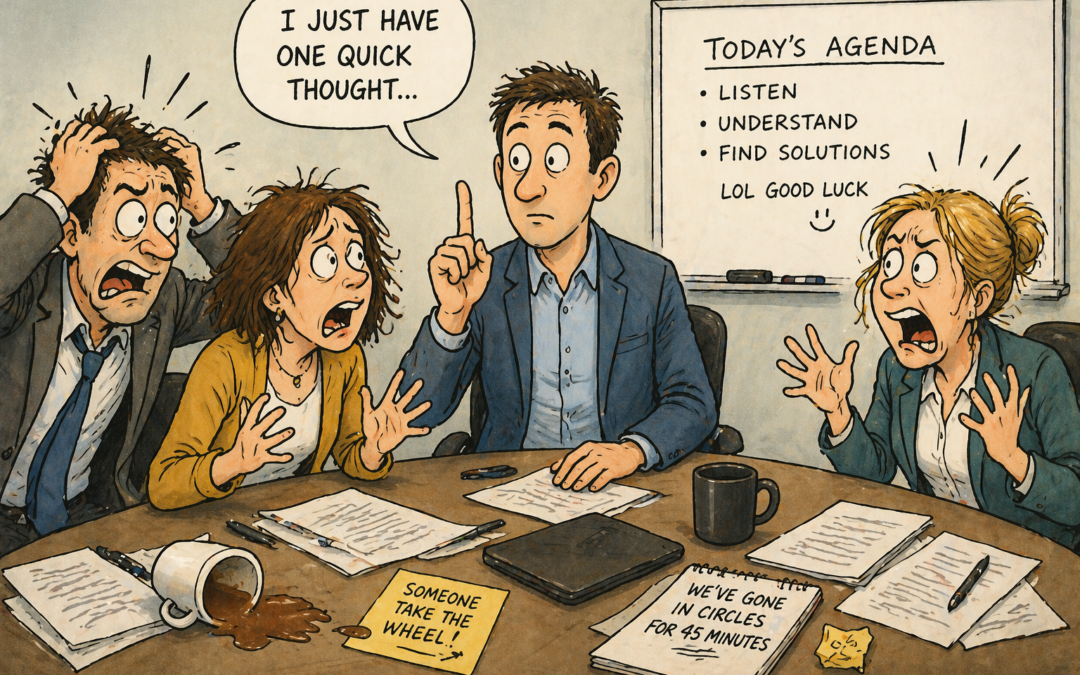
When to Interrupt in Mediation Is a Call You Have to Make
One of the hardest judgment calls in mediation is knowing when to interrupt in mediation.
People need room to talk. They need to feel heard. Sometimes they need to say something badly before they can say it well. If you interrupt too quickly, you can shut down something important.
At the same time, not every conversation deserves unlimited runway. Sometimes a person repeats, escalates, rambles, or causes damage. Sometimes the process needs protection.
That is the call a mediator must make. Getting it right requires constant attention to what the process needs.
Make the Call. Do Not Let Your Lizard Brain Make It for You.
A good interruption is a choice, not a reaction.
I want to be deliberate about my choices rather than reactive about my responses.
That is because bad interruptions usually come from reactivity. It tends to show up in a few predictable ways:
Anxiety: The mediator feels the process slipping and jumps in too fast to regain control.
Impatience: The mediator gets tired of repetition or slow progress and cuts someone off to move things along.
Frustration: The mediator is irritated by the person or their behavior and responds with an edge rather than with judgment.
Ego: The mediator feels challenged, misunderstood, or personally triggered and interrupts out of defensiveness or a need to take control.
These are easy traps to fall into. They feel justified in the moment. But in reality, they are just plain reactive and less effective.
Good interruptions come from slow, methodical, careful judgment about what the process needs next. You are tracking what is happening and deciding what matters. Then you choose your next move carefully.
The Move Starts Before You Open Your Mouth
A good interruption starts before you speak. It starts with a pause. For that, I use B.R.E.A.T.H.E.
B.R.E.A.T.H.E. is a reset sequence for the mediator:
B = Breathe — Take a slow, deliberate breath. Pause fully. Interrupt the threat response.
R = Recognize — Notice what is happening inside you and around you. Are you tense? Is someone about to blow, or is the other party shutting down?
E = Ease your body — Unclench your hands and drop your shoulders. Let your body signal that it is safe to stay present.
A = Anchor — Remember why you are there. Hold the structure of the process. Do not absorb the conflict or try to fix the people.
T = Tune in — Listen past the surface. Is there fear under the anger? Shame driving the aggression? A need for control that has gone unmet?
H = Hold boundaries — Stay calm and hold firm boundaries. Address harmful behavior and redirect when it interferes with the process.
E = Engage with empathy — When the intensity settles, connect. Name what you saw.
Without that pause, we tend to go on reactive autopilot. With the pause of B.R.E.A.T.H.E., we take charge of our actions and act with purpose.
When to Interrupt in Mediation: Here Is When I Step In
The real question is whether the interruption will help move the process in a deliberate direction.
I interrupt when I am protecting the process.
Here is what it looks like:
Stopping damage before it builds.
Cutting off repetition that is burning time and getting us nowhere.
Redirecting a conversation that has stopped being productive.
Stepping in before one party says something that will make resolution harder.
But I do not interrupt just because something is uncomfortable. Some of the best moments in mediation are uncomfortable. A person may finally be saying something real. A party may be struggling their way toward a point that matters. The moment may feel awkward because something important is actually happening.
Interrupting too soon is counterproductive. I have seen many mediators lose the process by stepping in early in an effort to control it. In those moments, the better move is to push your chair back and listen.
A mediator needs to know that difference.
If the process is still moving somewhere useful, let it run.
If the process is breaking down, protect it.
That does not always mean saying something. Sometimes the most effective interruption is a deliberate silence or even stepping out of the session. Miles Davis famously said, “It’s not the notes you play, it’s the notes you don’t play.” The same is true here. What you choose not to say can move the process just as much as what you say.
One Time I Hit the Table and It Worked
A few years ago, a difficult client in caucus kept repeating himself and saying inappropriate things with no self-regulation at all. I made a deliberate choice at that moment to interrupt hard. So, I slammed my hand on the table. Now I would never recommend that as some general technique, and I would certainly not advise people to start pounding on furniture. But it was effective there because it was chosen carefully.
I had thought through who was sitting across from me. He was an athlete, a football player, and a Marine. We were in caucus, so there was no audience and no face problem. He needed a jolt. He did not experience it as an attack. Rather, he experienced it as a coaching move.
What mattered even more was what came next. I stopped, paused, and took a breath. I lowered my vocal tone and slowed my cadence. Then I said, “If you continue in this way, then we will not get anywhere. Would you like to change direction and go somewhere?” Then I waited in silence for his answer.
That interruption worked because it matched the person, the setting, and the needs of the process. It was not anger or frustration. It was not me losing control. Instread, it was a strategic, deilliberate and planned choice to intervene.
One Time I Lost It, and It Did Not Go Well
I have also gotten it wrong.
Once, I had a case with a client who was nasty, demeaning, and dropping F-bombs throughout the session. I never swear. Part of that is my faith, and part of it is that I think it usually signals lazy thinking. In that session, an F-bomb just fell out of my mouth before I even realized what happened. I was horrified with myself.
Afterward, I thought it through and realized what had happened. I had let the client control me. I had matched her manner and lowered myself. That was my mistake. I was embarrassed by myself and decided I would never let that happen again. I’m better than that.
In the first example, I was in control. In the second, the lizard brain took over. Lizard brains were great for when our ancestors were running from saber-toothed tigers. They are not very helpful when people are trying to divide a pension.
That is the difference between an intervention and an attack. An intervention is a choice. An attack comes from reaction.
Sometimes the Right Move Is to Walk Out
I saw that difference even more clearly in another case. Two clients were being awful to each other. I have a high tolerance for bad behavior, but they were getting close to the edge for me. I could feel myself starting to lose patience.
So I did not push through it. I interrupted the process by leaving the room.
I told them, “I am finding myself having a very difficult time with the behavior I am witnessing between the two of you. Right now, I am going to excuse myself and will return in a moment. I am not certain when I return if I will wish to continue with this mediation.” Then I calmly walked out and went to the restroom.
In the restroom, I looked in the mirror and did B.R.E.A.T.H.E. I slowed myself down. and cleared my thoughts. I took about ten minutes and came up with a plan.
When I came back, I thanked them for giving me time to collect my thoughts. I told them openly that I was triggered and that one of the important skills in mediation is staying in control of oneself. Then I asked whether they wanted to continue. They said they did.
I said, “If we are going to continue, then I will need some things in the way you speak to each other to change.” Then I laid out the ground rules I needed to keep going. I asked each of them for a verbal commitment. “Are you willing to let the other person finish before you begin speaking?” “Are you willing to speak to each other with respect?”
Those choices mattered. I used “if-then” statements and “I” statements. I framed each ground rule as a positive action instead of a prohibition. Let the other person finish is better than do not talk over each other. Speak with respect is better than stop being rude.
That reset worked because I got myself under control before I tried to guide the clients.
This Is Not About Looking Good
A mediator should not interrupt to perform. A mediator should not try to look dramatic, clever, or powerful. Some interventions carry energy. A firm interruption, a hand on the table, walking out of the process. From the outside, those things can look performative. They should not feel performative.
I am not here to perform. I am here to help the process move.
That is the standard.
The move has to be deliberate and fit the moment. It has to serve the process and cannot be a discharge of the mediator’s own frustration. An intervention cannot become manipulation. We are helping the clients change directions.
When to Interrupt in Mediation: The Standard I Use
So when should you interrupt?
Interrupt when the process needs protection.
Let it run when the process is still doing useful work.
Step out when you need to regain control of yourself before trying to guide anyone else.
Before you speak, ask yourself one question.
Am I making a choice right now, or am I just having a reaction?
That question will save you a lot of bad interruptions.
Burnout in family law generally shows up as overload, with too many roles, too many expectations, and not enough structure around who is responsible for what. Reducing burnout in family law starts with how the work is structured, not just how hard you push through it.
In many cases, one professional is carrying legal analysis, emotional dynamics, plus the financial side of the case at the same time. That is a heavy lift. It wears people down.
There is a better way to structure the work.
What Interdisciplinary Collaboration in Family Law Looks Like
Interdisciplinary collaboration in family law is one of the hallmarks of Collaborative Practice, an international movement that has reshaped how professionals approach family conflict. The model brings lawyers, financial professionals, and mental health professionals into a coordinated process with defined roles and shared responsibility. However, the principles travel well beyond Collaborative Divorce. Practioners can apply these principles in mediation and other family law settings where the goal is thoughtful, durable resolution.
Interdisciplinary collaboration in family law brings attorneys, financial professionals, and mental health professionals into the same process with clear roles. Each person takes responsibility for the part of the case they are trained to handle. As a result, the work becomes clearer, and the pressure eases. Outcomes tend to hold up.
How a Team-Based Family Law Approach Improves Outcomes
Clients benefit because a team-based family law practice puts the right problems with the right professionals. Financial questions get answered early instead of lingering in the background. The team manages emotional escalation before it derails the process. The legal work stays on track. Agreements come together more cleanly and tend to hold up over time.
Additionally, professionals benefit in a team-based family law practice. Working on teams helps you stay within your training. You are not stepping into financial analysis without the background or trying to manage emotional escalation without the right tools. You are doing your work, and doing it well.
The Three R’s Framework for Family Law Collaboration
I think about this as the Three R’s.
The right people
To do the right work
For right price.
“The right people” means building a team that understands both their role and how to work together.
“To do the right work” means each professional takes ownership of their piece of the process.
“For the right price” means clients are paying for the appropriate level of expertise instead of using one professional to cover everything.
When those three line up, cases move with less friction. You spend less time cleaning up confusion and more time helping people make decisions that stick.
Building an Interdisciplinary Family Law Practice
Working in interdisciplinary family law teams changes how you see cases. You start to catch patterns earlier and hear language that lands better with clients. You become more precise in your own role.
A Practical Shift in How You Run Cases
This is a structural choice about how to run a case.
If your practice feels heavy, look at how you carry the work. Collaboration in family law is often the missing structure. You may be holding parts of the case that belong with someone else.
Find the right people. Let them do the right work. Set it up at the right price.
That is how you build a practice that holds up over time.
In California, mediation is a popular alternative to traditional courtroom proceedings for resolving conflicts, including divorce cases. One crucial aspect of the mediation process is confidentiality. Maintaining confidentiality ensures parties can freely express their concerns, explore options, and work towards mutually agreed solutions. In this blog post, we will delve into the details of confidentiality in the mediation process under California law.
Confidentiality in Mediation
Confidentiality is a basic principle for the mediation process in California. California Evidence Code sections 703.5 and 1115–1128 outline the rules and protections regarding confidentiality in mediation. These laws aim to foster an open and honest environment where parties can work things out without fear of their statements being used against them later in court.
Confidential Communications
Pursuant to the California laws on mediation confidentiality, communications made pursuant to mediation are confidential. This means that parties, mediators, and any other parties cannot be forced to share what was said during mediation in court. This rule extends to both the content of the communications and any documents prepared specifically for mediation.
California Evidence Code section 1119 provides in particular:
(a) No evidence of anything said or any admission made for the purpose of, in the course of, or pursuant to, a mediation or a mediation consultation is admissible or subject to discovery, and disclosure of the evidence shall not be compelled, in any arbitration, administrative adjudication, civil action, or other noncriminal proceeding in which, pursuant to law, testimony can be compelled to be given.
(b) No writing, as defined in Section 250, that is prepared for the purpose of, in the course of, or pursuant to, a mediation or a mediation consultation, is admissible or subject to discovery, and disclosure of the writing shall not be compelled, in any arbitration, administrative adjudication, civil action, or other noncriminal proceeding in which, pursuant to law, testimony can be compelled to be given.
(c) All communications, negotiations, or settlement discussions by and between participants in the course of a mediation or a mediation consultation shall remain confidential.
Exceptions to California Mediation Confidentiality
While mediation is generally confidential, there are a few exceptions where information shared during mediation may be admissible in court. These exceptions include situations involving threats of harm or criminal acts, child abuse, and certain financial crimes. Additionally, if all parties –including the mediator– agree in writing, they can waive the confidentiality. (See California Evidence Code Section 1122.)
Evidence Code Section 1120 specifically spells out the following circumstances when the confidentiality does not apply:
Evidence otherwise admissible in court or subject to discovery is not excluded simply because it was brought up during mediation.
An agreement to mediate is admissible.
An agreement not to take a default or an agreement to extend time is not confidential.
The mere fact a particular mediator is serving on a case is not confidential.
The family law declarations of disclosure required in every divorce case by Family Code sections Sections 2104 and 2105 are admissible, even if the parties prepared them during mediation.
Confidentiality in California mediation processes offers several benefits to the parties involved:
Open Communication: Confidentiality encourages open and honest communication between the parties. It allows them to express their concerns, feelings, and interests without fear of their words being used against them later.
Privacy: Mediation provides a private and confidential setting to discuss sensitive information without becoming public record. This confidentiality protects personal and financial matters from unnecessary exposure.
Preserving Relationships: Confidentiality allows parties to work collaboratively towards resolving their issues. By safeguarding private information, it helps maintain trust and respect, increasing the likelihood of preserving relationships, especially in family law cases.
Creative Problem-Solving: Parties can freely explore various options and potential solutions during mediation, knowing that their ideas and proposals will remain confidential. This freedom fosters creativity and facilitates a more comprehensive resolution of the dispute.
Conclusion
Confidentiality is a crucial aspect of the mediation process under California law. It creates a safe space for open communication, protects privacy, and supports the development of mutually agreed solutions. It’s important for all involved parties to understand the rules and exceptions regarding confidentiality in mediation. By ensuring confidentiality, mediation provides a valuable alternative to traditional litigation, promoting better results for those seeking resolution in California’s legal system.
Along the banks of the Ho Truc Bach Lake in downtown Hanoi, Vietnam is a monument sculpted from stone.
It’s an image of a person with arms raised and head lowered. The monument portrays the fateful moment in October 1967 when then U.S. Navy pilot John McCain was captured. The monument text, roughly translated, reads:
“On 26 October 1967 near Truc Bach Lake in the capital, Hanoi, the citizens and military caught Pilot John Sidney McCain. The US Navy Air Force Aviator was flying aircraft A4, which crashed near Yen Phu power station. This was one of ten aircraft shot down that same day.”[1]
The John S. McCain monument at Bruc Back Lake. Photo: Jim Bryant, U.S. Navy
Fast forward to August 27, 2018.
A 62-year-old Vietnamese man, Pham Van Khanh, brought flowers to the McCain monument in Hanoi.[2] He joined countless other Vietnamese who wished to honor their former captive.[3]
Even McCain’s jailer and operator of the prison, former Col. Tran Trong Duyet, said, “When I learnt about his death early this morning, I feel very sad. I would like to send condolences to his family. I think it’s the same feeling for all Vietnamese people as he has greatly contributed to the development of Vietnam-U.S. relations.”[4]
How could a nation that reviled and tortured the late Senator have such love for him after his death? Because of Senator McCain’s work along with former Senator and Vietnam Veteran John Kerry to normalize relations with Vietnam, the Vietnamese government now reveres him as a “symbol of his generation” who helped “heal the wounds of war.”[5] This mutual respect between Senator McCain and his former captors exemplifies the many times McCain rose well-above a conflict to find common ground and to make peace.
John McCain with his Navy Squadron (botrrom right). Photo: Library of Congress
I have never met Senator John McCain, but as a professional peacemaker I relate to his peacemaking words and consider him a peacemaking soulmate.
We all know the story of how McCain was shot down over Vietnam, beginning his terrifying and heroic stay at the infamous Hanoi Hilton prison. Refusing to be released before his brothers-in-arms, the North Vietnamese tortured him mercilessly and placed him in solitary confinement.[6]
His captors didn’t release McCain until after the signing of the Paris Peace Accords on March 14, 1973. Though free, he carried substantial injuries for the rest of his life.
As a Senator, he was known for his work across the political aisle. Sometimes he angered the more strident members of his party for taking the higher ground.
Senator McCain admits to his imperfections, and has apologized for his less than peaceful remarks at times.
For example, he famously used a racial slur to describe his captors, feeling he had a right to describe his former captors with any language he chose. He later reconsidered and apologized, and removed the word from his vocabulary.[7]
This man is considered a hero today in large part because he made a career of rising above the fray of the negative discourse that pervades American politics today. Perhaps most famously, he defended Barrack Obama against people who accused Obama of being “Arab”, saying “No ma’am. He’s a decent family man and citizen that I just happened to have disagreements with on fundamental issues.”
Senator John McCain meets with President Barack Obama in the Oval Office in 2011. Photo: Pete Souza, White House Photo Office
It’s telling that two of his principle political rivals, Former President’s Obama and Bush, will eulogize him at his memorial service.[8]
John McCain’s thoughts on the need to ‘win’ at all costs
Most recently, when speaking to the Senate with a request for a return to regular order in the Senate in the wake of a difficult debate on healthcare reform in 2017, McCain said the following to support his plea:
“I’ve known and admired men and women in the Senate who played much more than a small role in our history, true statesmen, giants of American politics. They came from both parties, and from various backgrounds. Their ambitions were frequently in conflict. … And they often had very serious disagreements about how best to serve the national interest.
“But they knew that however sharp and heartfelt their disputes, however keen their ambitions, they had an obligation to work collaboratively to ensure the Senate discharged its constitutional responsibilities effectively.
“Both sides have let this happen. Let’s leave the history of who shot first to the historians. I suspect they’ll find we all conspired in our decline – either by deliberate actions or neglect. We’ve all played some role in it. Certainly I have. ….
“Incremental progress, compromises that each side criticize but also accept, just plain muddling through to chip away at problems and keep our enemies from doing their worst isn’t glamorous or exciting. It doesn’t feel like a political triumph. But it’s usually the most we can expect from our system of government, operating in a country as diverse and quarrelsome and free as ours.
“…. It is our responsibility to preserve that, even when it requires us to do something less satisfying than ‘winning.’ Even when we must give a little to get a little. Even when our efforts manage just three yards and a cloud of dust, while critics on both sides denounce us for timidity, for our failure to ‘triumph.’
“I hope we can again rely on humility, on our need to cooperate, on our dependence on each other to learn how to trust each other again and by so doing better serve the people who elected us.”
John McCain was a peacemaker
Senator John McCain walks with Vice President Mike Pence on the 75th anniversary of the Pearl Harbor attack in Honolulu, Hawaii. Photo: US Army. Jose A. Torres, Jr.
I read the words spoken by Senator McCain last year and listened to them again. I have a soulmate in Senator McCain. We have never met, but as a professional peacemaker I relate to his peacemaking words.
I have often thought the woes of Washington, D.C. could be greatly reduced if some mediators could head to Capitol Hill. We professional peacemakers understand that peace and agreement requires people who disagree to disagree agreeably. “Compromise” is not a dirty word. Rather, a compromise allows for differing people to find a common ground. The all-or-nothing subjective myths of “justice” or “fairness” give way to the higher principles of collaboration, mutual respect and peace.
As a divorce mediator, I am involved in helping people find pathways to settlement in the toughest of times.
There are very few experiences as heart-wrenching and personally painful as divorce. Consequently, my aim is to help others learn how to work together while experiencing peace. It’s possible.
Senator McCain’s approach to politics parallels my Dolphin Lawyering philosophy and approach to dispute resolution. Unlike some of my shark-like colleagues in the legal profession, I strive for a more humane approach encouraging peaceful outcomes. I therefore live by the creed, “It’s not just a legal process; it’s a human experience.”
Like Senator McCain, I look back on the contentious moments of my past career as a divorce litigator. Similarly, I realize that at times I didn’t always live up to my greatest ideal. But whenever I have embraced peacemaking and mutual respect, I have not only worked as an instrument for others to find peace, but I have experienced my greatest professional joy: helping others.
While many may disagree with political stands by Senator McCain, perhaps we can take his life as a shining example of a peacemaker a person of any political persuasion can follow. I, for one, am certainly grateful for his imperfect, yet sincere example.